Hidden Photography Gems in Cambridge: 8 Secret Spots Most Visitors Never Find
King’s College Chapel. The Bridge of Sighs. The Backs. The Senate House. These are Cambridge’s canonical photography locations, extraordinary places undeniably, but also thoroughly documented and endlessly photographed. On a summer morning you will share these spots with hundreds of other people holding cameras.
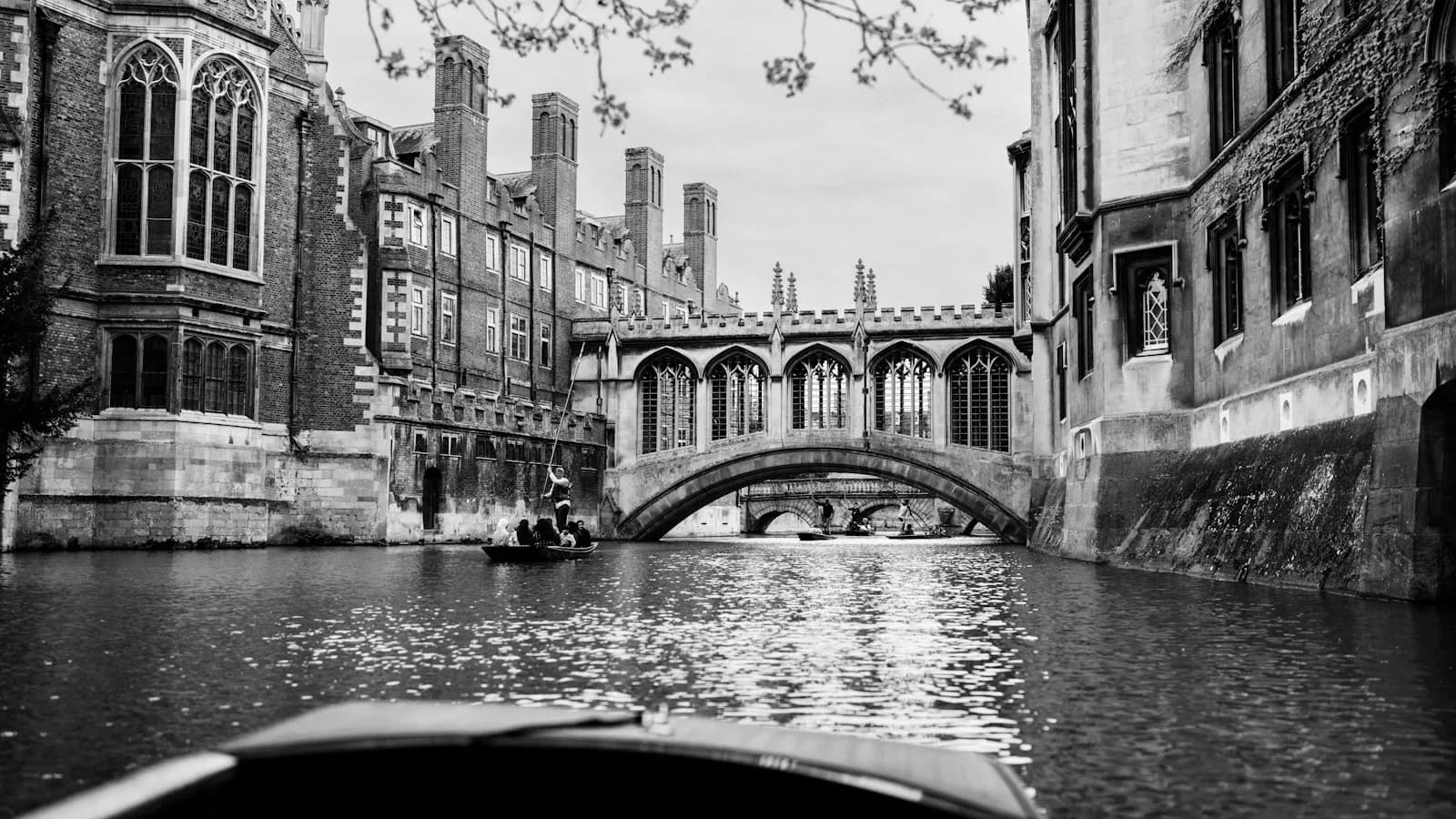
Cambridge rewards the curious. Behind the famous façades are courtyards, passages, rooftops and corners that most visitors never find, and that offer photography that is genuinely distinctive: atmospheric, uncrowded, and quietly beautiful in ways that postcard Cambridge rarely is. Here are eight of our favourites. For the classics done well, see my guide to the best photography locations in Cambridge.
Corpus Christi College Clock and Chronophage
Installed in 2008 on the corner of Bene’t Street and King’s Parade, the Corpus Clock is one of the most extraordinary time-keeping sculptures in the world. The golden disc, three feet in diameter, displays the time through illuminated slits controlled by a mechanical grasshopper, the Chronophage or time-eater, that devours each minute as it passes.
At night, illuminated against the dark stone of Corpus Christi College, it is surreal and magnificent. Few tourists come after dark, which is when the best photographs happen. Best time: after 9pm on a clear evening, with a long exposure, wide aperture and low ISO.
St Bene’t’s Church and Belfry
St Bene’t’s is the oldest building in Cambridgeshire; parts of the tower date from 1020 CE. It is tucked behind a modest exterior on Bene’t Street, and most people walk past without a second glance. The Saxon tower is photographic gold: ancient stone, deeply weathered, with arched windows that have not changed in a thousand years.
The small churchyard behind the building offers a remarkable juxtaposition of medieval and modern: the ancient tower against the contemporary city skyline visible in the background.
Cherry Hinton Chalk Pits
Three miles from the city centre and virtually unknown to visitors, Cherry Hinton chalk pits offer a dramatic landscape that feels entirely unlike anything else in the Cambridge area. The exposed white chalk faces, scrubby grassland and small ponds created by former quarrying create a textured, atmospheric environment perfect for creative photography.
During portrait sessions here, the chalk face acts as a natural reflector, bouncing warm, diffused light onto subjects even on overcast days. It is one of the few locations in Cambridge where you can achieve genuine drama in both landscape and portraiture. Access: Limekiln Road, Cambridge, with free parking adjacent to the site.
The Wren Library Interior, Trinity College
The Wren Library at Trinity College, designed by Christopher Wren and completed in 1695, is one of the great Baroque library interiors in England. Carved limewood bookcases by Grinling Gibbons, marble floors, busts of great scholars, and natural light entering through tall windows create an atmosphere of extraordinary beauty.
The library is open to the public on weekday mornings (Monday to Friday, 12:00 to 14:00 during term). Photography for personal use is generally permitted with care: no flash, no tripod. The quality of light inside is extraordinary around noon.
Trinity Great Court at Night
Trinity College Great Court, the largest enclosed court in Oxford or Cambridge, is spectacular in daylight but genuinely magical in the early evening, when the warm interior light of the college spills through the archways and the court is lit from below.
Access for non-members is limited to daylight visiting hours, but the court is sometimes visible through the Great Gate on Trinity Street in the evening. The scale and architecture are extraordinary even from outside.
Laundress Lane and the Mill Pond
Laundress Lane is a narrow alley running from Silver Street toward the River Cam, one of the smallest and most atmospheric lanes in Cambridge. The combination of ancient brick, overgrown walls and the sudden emergence onto the Mill Pond and Silver Street Bridge creates a wonderful sequence of photographic moments.
The Mill Pond itself is excellent for long-exposure water photography in low light. Punts moored overnight create beautiful foreground interest when shot with a slow shutter speed.
Midsummer Common at Dawn
Most visitors never see Cambridge at 5:30am in summer, but those who do are rewarded with something remarkable: mist rising from the common, cattle moving slowly across the grass, the backs of terrace houses reflected in the Cam, and an almost complete absence of other people.
Midsummer Common offers a completely different Cambridge from the tourist experience: a working fenland landscape on the city’s edge, with the towers of the city rising behind and enormous open sky above. What to bring: a tripod, a wide-angle lens and waterproof boots. This is also a wonderful dawn spot for golden hour photography.
The Mathematical Bridge, Queens’ College
Lesser-visited than the Bridge of Sighs but arguably more interesting, the Mathematical Bridge at Queens’ College is a wooden bridge joining two parts of Queens’ across the Cam. It was originally constructed in 1749 using tangential timbers that gave it its distinctive arch shape without a continuous curve.
The bridge is visible from the Silver Street Bridge without entering the college. For the best composition, shoot from the bridge below and slightly upstream, where the wooden structure frames beautifully against the college buildings and riverside vegetation.
Photography Permissions in Cambridge
A word on permissions. Cambridge’s colleges are private property, and access for photography, particularly commercial photography, varies significantly between them. For personal photography during public visiting hours, most locations are accessible. For any professional or commercial session, contact the relevant college Porters’ Lodge in advance. The city’s streets, riverbanks and public parks are, of course, freely accessible.
Explore Cambridge Through a Different Lens
The best way to discover Cambridge’s hidden photographic possibilities is with someone who knows where to look. At Immortal Photography we offer bespoke portrait sessions and photography that take you beyond the obvious, into the alleys, courts and quiet corners that reveal a very different, equally beautiful Cambridge.
For an outstanding free resource on Cambridge and Cambridgeshire photo spots, PhotoHound’s Cambridgeshire guide has 44 mapped locations. For photography gear suited to architectural and low-light work, Park Cameras are our recommended UK retailer.
Related services
FAQs
- What are some lesser-known photography spots in Cambridge?
- Beyond the famous landmarks, try the Corpus Clock at night, St Bene’t’s Saxon tower, Cherry Hinton chalk pits, the Wren Library interior, Trinity Great Court, Laundress Lane and the Mill Pond, Midsummer Common at dawn, and the Mathematical Bridge at Queens’ College.
- When is the best time to photograph the Corpus Clock?
- After 9pm on a clear evening, when it is illuminated against the dark stone of Corpus Christi College. Use a long exposure, a wide aperture and a low ISO to capture the drama that most daytime visitors miss.
- Can I photograph inside Cambridge college libraries and courts?
- Some allow personal photography during public hours. The Wren Library, for example, opens to the public on weekday lunchtimes in term and permits careful personal photography with no flash or tripod. For commercial shoots, always contact the college Porters’ Lodge in advance.
- Do I need permission to photograph in Cambridge?
- The city’s streets, riverbanks and public parks are freely accessible. Colleges are private property, so access varies, and any professional or commercial session inside college grounds should be arranged with the relevant Porters’ Lodge beforehand.
Planning a celebration?
Tell us about your event and we will reply within one working day.
More from the journal
All articles →